

This guide is for Filipino agency owners and self-employed operators who want to lower their tax bill legally by claiming the right deductions with solid proof.
Running an agency is not just client delivery. It is retainers, project invoices, subscriptions, contractor payouts, reimbursements, rush costs, and the occasional urgent purchase that suddenly becomes part of the workflow.
The expenses are real. The problem is the trail, especially when you are managing agency expense deductions across multiple clients.
That is why receipt management matters more than most agency owners expect.
BIR does not care that you were busy. They care whether your claimed expense is connected to earning income and supported by proper records.
When the paper trail is weak, a real business cost can get treated like a personal expense fast.
The simplest rule to keep you safe is this: claim a deduction only when you can support it with documentation and explain the business purpose clearly. If you do that consistently, filing becomes routine instead of reconstruction.
If you manage clients and a team, this matters more. Missing records can turn real operating costs into non-deductible costs fast, especially during a review.
Let’s break this down.
Key takeaways
- Agency deductions work best when you track expenses the way agencies actually spend.
- Separate pass-through costs from operating costs so your margins stay honest. Require documentation for reimbursements and contractor payouts so payments do not turn into mystery expenses.
- Use business expense categories that reflect delivery, operations, growth, compliance, and assets so quarterly and annual filing stays clean.”
- Home office claims can work when they are computed consistently and kept reasonable.
The top expense problems agency owners face
Agencies usually do not lose money because they lack deductions. They lose money because they cannot defend their deductions and cannot see what is actually profitable.
Problem 1: You cannot tell what is yours versus the client’s
This is where profit quietly leaks.
Agencies often pay for things that should be client costs, like stock assets, printing, courier fees, boosted posts requested by the client, location fees, props for shoots, or rush purchases needed for a specific deliverable. If you record these as your agency operating expenses, your financials will make your best accounts look weaker than they are.
Create a pass-through lane. Before you spend, save proof of client approval. Keep it with the receipt or invoice. Then bill it back clearly on the invoice so it stays visible as a client cost, not as a cost of running your agency.
Problem 2: Reimbursements turn into mystery expenses
A teammate buys something, you reimburse them, and the receipt disappears. Later you have a payment record with nothing supporting it. That is how normal expenses become hard to claim.
Set a reimbursement rule that protects the business. Require the receipt photo, a one-line purpose, and a client or project tag. Attach payment proof. If the documentation is missing, the reimbursement does not get processed. It is not harsh. It is how you keep deductions defensible.
Problem 3: Contractor payments have no paper trail
Agencies pay contractors quickly because delivery matters. But when you pay without documentation, the expense becomes difficult to support later.
Make payment conditional on paperwork. Before you pay, collect an invoice or billing statement and add a one-line scope note. Save the transfer screenshot with it.
Tag the client or retainer the work supports. This keeps contractor spend clean, searchable, and explainable.
Learn more about receipts and invoices here.
What are common expense deductions for agency owners?
Agency owners typically have deductions across five lanes: delivery, operations, growth, compliance, and assets. Thinking in these lanes helps because agencies do not just spend money to do work. You spend money to deliver, coordinate, sell, and stay compliant.
Work tools and software
Subscriptions and tools used to deliver client work and run operations can be deductible. This includes design tools, editing tools, cloud storage, project management tools, communication tools, and email platforms. For agencies, it helps to note whether a tool is used for delivery, internal coordination, or both, especially when multiple team members use it.
Internet and communication costs
Internet and communication costs are commonly claimed, but agencies often share lines with personal use. A reasonable allocation that stays consistent month to month is easier to defend than changing your percentage whenever it is convenient.
Equipment and devices
Laptops, phones, cameras, lighting, and office equipment used for the business can qualify. Larger purchases are often treated as assets depending on how you account for them. What matters for you operationally is keeping the invoice and payment proof and recording the purchase properly so you are not guessing later.
Contractors and outsourced help
Payments to editors, designers, developers, media buyers, VAs, and other outsourced support can be deductible when they support income generation and operations. The agency-specific risk is not whether the work is legitimate. The risk is missing documentation.
Keep the invoice or billing statement, payment proof, and a one-line scope note together. Tag the client or retainer when the work is tied to a specific account. This protects you during filing and also helps you see which accounts are contractor-heavy.
Team reimbursements and client pass-through costs
These are not the same as operating expenses, so treat them differently. Reimbursements need receipt, purpose, and payment proof. Pass-through costs need receipt plus proof of client approval, then billing back to the client clearly. When you separate these properly, your deductions stay cleaner and your margins stop lying.
Marketing and advertising
Growth spend like ads, boosted posts for your own agency, website hosting, domain renewals, lead gen tools, CRM tools, and content production can be deductible when they support earning income. Agencies should keep growth spend separate from delivery spend so you can see whether you are investing in pipeline or simply spending more to fulfill work.
Professional fees and compliance costs
Bookkeeping, accounting support, filing support, and business-related consultations are often deductible when tied to operations. This is also one of the best spends an agency can make because it reduces costly mistakes and keeps your documentation in order.
Check out a full list of items you can declare as expenses here.
How to claim home office expenses
Home office claims can work when you use a dedicated work area and compute a reasonable business-use share consistently.
Start with a defined workspace, not a shared surface you also use for personal life. Then choose what you will allocate, usually rent and utilities first, plus internet when it is clearly used for business.
A simple method is area-based allocation. Divide workspace area by total home area, then apply that percentage to eligible costs.
Example: Workspace is 6 sqm and home is 60 sqm, so business share is 10 percent. If rent is ₱25,000 and electricity is ₱3,000, the allocable portion is ₱2,500 rent and ₱300 electricity for that month.
Keep bills, payment proofs, and a short computation note. Record it monthly so your method stays consistent. If your claim feels aggressive, it becomes harder to defend. Keep it reasonable.
How to categorize business expenses for your agency
Categorization should help you file faster and understand the business better. For agencies, categories work best when they map to how you actually run projects and protect margin clarity.
Delivery costs cover client work expenses like contractor pay, project tools, production costs, and transaction fees tied to delivery.
Operating costs cover what keeps the agency running like internet, phone, admin tools, coworking or rent, supplies, and bank charges.
Growth costs cover demand-building like ads, hosting, domains, CRM tools, email marketing platforms, and sales tools.
Compliance and professional services cover bookkeeping, accounting, filing help, and legal consults.
Assets cover major purchases like laptops, cameras, and office furniture.
One practical agency upgrade is adding a client or retainer tag when the expense is tied to delivery. This helps you see margin per account without doing a forensic audit later.
How Taxumo helps with expense tracking
Taxumo makes expense tracking easier to keep up with. You log income and expenses in one place. Your numbers stop living in spreadsheets, bank apps, and screenshots.
You can attach receipts as you record expenses. That keeps your paper trail intact. It also saves you from chasing proof at the last minute
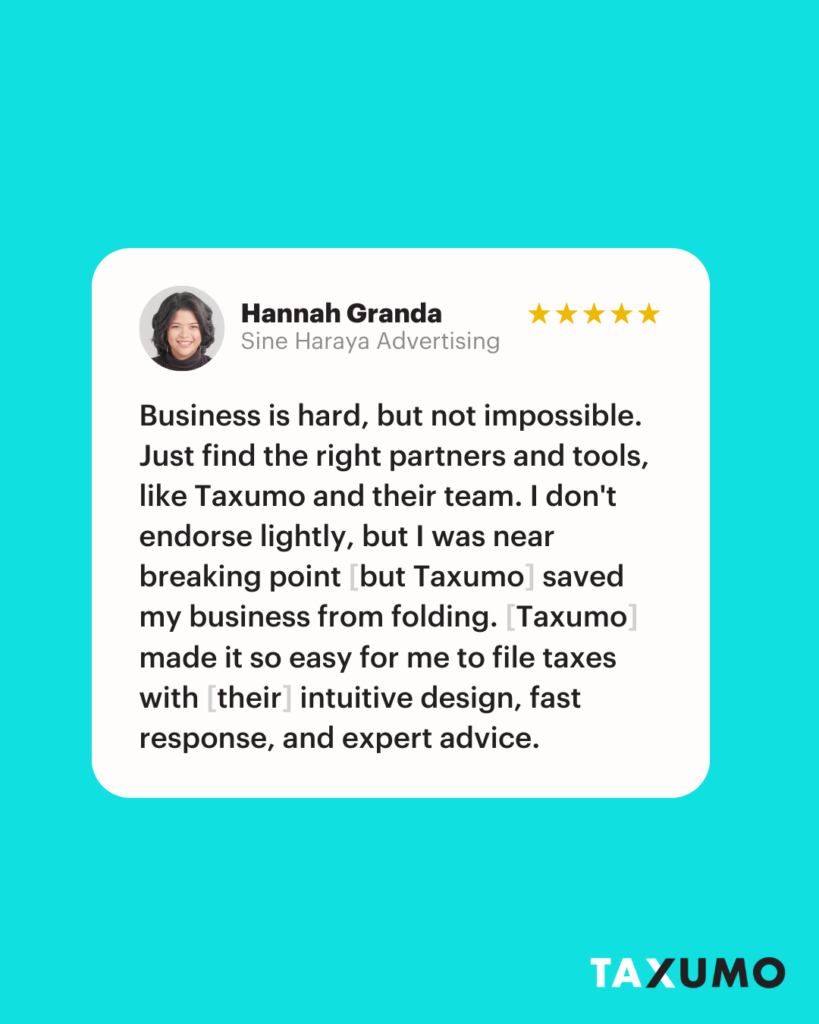
This fits agency life and makes it more manageable. Subscriptions renew monthly. Contractors get paid in batches. Reimbursements happen mid-project. Pass-through costs show up when a client needs something now. Taxumo helps you
record these consistently and keep the supporting files together.
It also helps when you have support.
You can loop in your accountant or bookkeeper. Tracking becomes shared, not owner-dependent. That makes quarterly filing less of a cleanup job.
Even when expenses do not reduce your tax the way you expect, tracking still matters. It protects cash flow.
It keeps records ready. It helps you answer questions fast when clients, banks, or compliance ask.
A quick checklist before you claim an expense
Here’s a quick guide on how to identify the right expenses for deductions.
Does it support income or operations?
Did you record it in the correct year?
Do you have a compliant receipt or invoice?
Can you explain the business purpose in one line?
If it is mixed-use, did you allocate it consistently?
If any piece is missing, fix it while the details are fresh. Do not wait until you are trying to remember what that random purchase was for six months later.
Final thoughts
For agency owners, taxes are not the point. Control is.
Clean tracking keeps deductions safe. It keeps your profit honest.
Compliance is leverage. Clients move faster when your docs are ready.
Banks trust numbers that make sense. And if records get reviewed, you stay calm because you can explain every claim.
Keep the next step simple. Build a weekly system you will follow.
If you want less admin dread, Taxumo helps you stay organized all year, stay aligned with deadlines, and stay filing-ready before April hits.